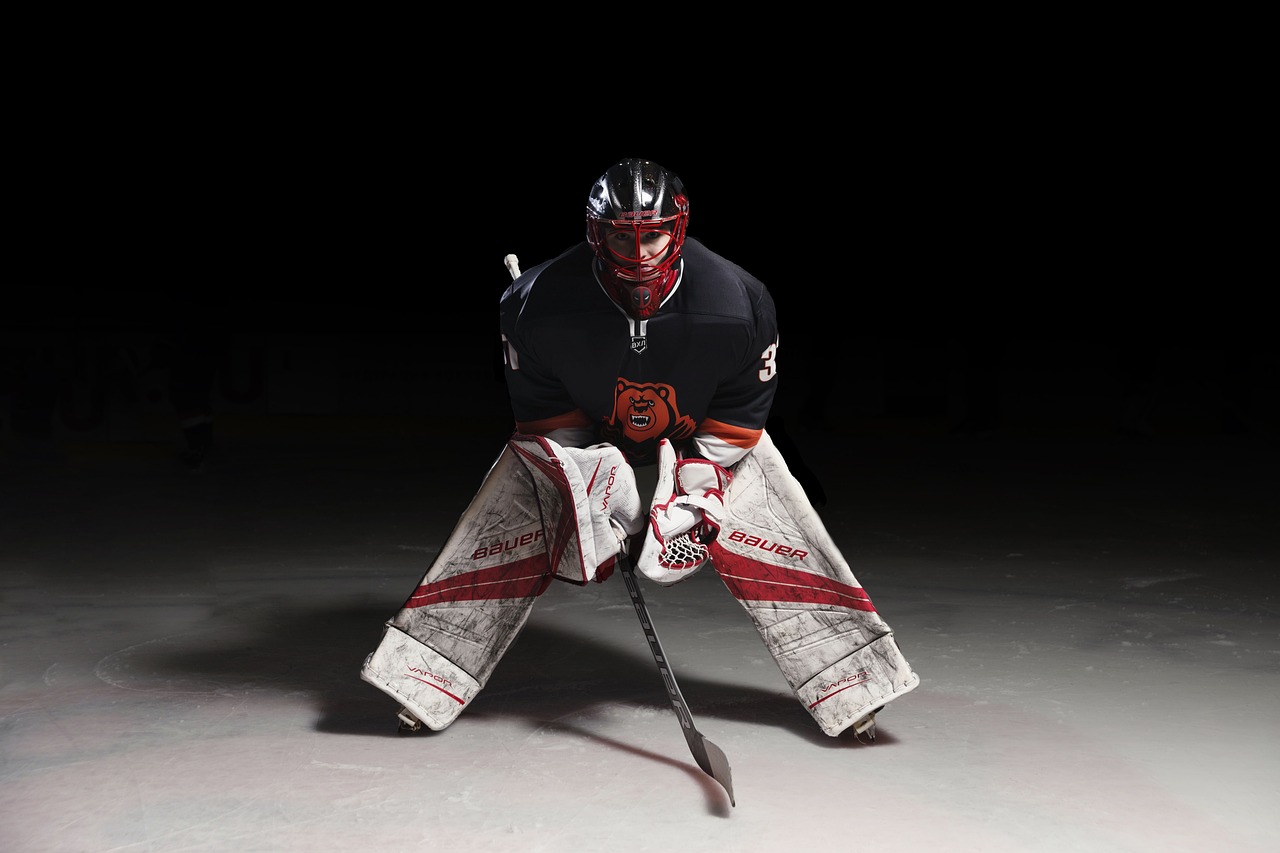
Put a radar gun on an NHL practice and you’ll get numbers that sound made up. A hard point shot from a defenseman crosses the 50-odd feet between the blue line and the crease in roughly a third of a second, and it arrives as a six-ounce disc of vulcanized rubber with a hard edge. A skater who takes one off the shin guard limps to the bench. A goaltender takes forty of them in a practice, from every angle, and is expected to be square to the next one before the rebound settles.
That’s the whole answer in miniature, but it isn’t a very satisfying one, because it doesn’t explain the specific shapes. Why is a chest protector built like a piece of body armor while a forward’s shoulder pads are a vest you could wear under a hoodie? Why does a leg pad have a flat face and a stiff outer roll, when a shin guard is a curved shell that wraps the leg? Why does a goalie glove have a cuff the size of a dinner plate and a skater’s glove is essentially a padded mitten?
Every one of those differences traces back to two questions: what is this piece of equipment expected to absorb, and what is the player wearing it expected to do afterward. Skaters are protected against incidental contact — a puck they didn’t see, a stick across the forearm, a hit into the boards. Goaltenders are protected against the sport’s primary action, repeatedly, on purpose, and they have to keep working while it happens.
Absorbing a puck is a different job from surviving one
A skater’s gear is built to spread a single impact over a wider area and get the energy into foam before it reaches bone. That’s enough, because the impact is unusual. Goalie gear has to do that and then control where the puck goes next, which is a completely separate engineering problem. A shin guard that flings a rebound into the slot is a perfectly good shin guard. A chest protector that does the same thing is a bad chest protector.
That’s why goalie padding is layered in a way skater gear isn’t — a dense outer face that kills the puck’s bounce, softer foam behind it that takes the sting out, and a stiff internal structure that keeps the whole thing from folding in on the body. It’s also why the outside of a modern leg pad is flat rather than rounded. A flat face sitting perpendicular to the ice in the butterfly seals more of the bottom of the net and sends pucks outward rather than straight back to the shooter’s stick. The rolled edge on the outside of the pad isn’t decoration; it’s the piece that steers pucks toward the corner.
The skaters aren’t underprotected, they’re differently protected
Position-by-position, the gear diverges more than most fans notice. A stay-at-home defenseman who blocks shots for a living tends to wear larger shin guards with more coverage down the ankle and around the calf, plus shot-blocking inserts on the skate itself — the plastic guard that wraps the outside of the boot, which almost nobody wore twenty years ago and most NHL defensemen wear now. Their gloves usually have a hard thumb and reinforced backhand, because the puck finds hands at the point.
Forwards trade coverage for mobility almost everywhere. Lighter shoulder caps, shorter elbow pads, gloves with more flex in the cuff so the wrists move freely on a shot. A skill forward often wears shoulder pads a physical winger would consider a rumor. Nobody makes them; it’s a private bargain each player strikes between getting hurt occasionally and being slightly slower all the time.
Goalies can’t make that bargain. They’re in the line of fire on essentially every offensive possession, so the calculation is never “will I get hit” but “how many times tonight.” When your exposure is guaranteed, you stop optimizing for the rare impact and start optimizing for the hundredth one.
The rulebook, not the goalie, decides how big the gear gets
Left alone, goalies would wear more. They did, for about fifteen years. Chest protectors ballooned, sweaters hung loose over the top, and leg pads grew until scoring collapsed — in 2003-04, teams averaged just 2.57 goals per game, the lowest figure since the mid-1950s, against a 1980s decade that never dipped below 3.67.
The corrections came in waves. An across-the-board reduction of roughly eleven percent arrived for 2005-06. Leg pads were eventually capped at 11 inches wide and 38 inches long, with the length scaled to each goalie’s measured height rather than issued as a flat maximum — a six-foot-six goaltender and a five-foot-eleven goaltender no longer get the same pad. Then came pants, and then, back in 2018, the chest and arm protector, which had quietly become the biggest offender.
That rewrite is worth understanding because it set the design language still in use. The governing idea, as the league described it at the time, was to build gear that mimics the shape of the body underneath it without reducing actual protection — stripping material from places where there’s no body part behind the padding. The result is a rule with genuinely fussy specifics: bicep and forearm padding has to taper down the arm rather than run as a uniform slab, and the floating pads over the collarbone can rise only a couple of inches above the shoulder at the outer edge, tapering to almost nothing toward the neck. Amateur rulebooks mirror most of it. USA Hockey’s goaltender equipment rule caps the blocker at 8 by 15 inches and the catch glove at a 45-inch circumference, and specifies that shoulder cap padding can’t exceed an inch of thickness beyond the top ridge of the shoulder.
There’s an enforcement wrinkle that makes these rules unusual: a chest protector legal on the hanger can become illegal on the goalie. If the shoulder protection gets shoved up above the collarbone when the goalie drops into a normal crouch, it’s illegal in that moment — the rule is written about the equipment as worn, not as manufactured.
Fit is the part the size chart can’t give you
Two goalies of identical height can need meaningfully different pads, because pad sizing is driven by the distance from ankle to knee and knee to mid-thigh, not overall height. Get it wrong and the knee lands off the knee block, which means the pad rotates late in the butterfly and leaves a gap along the ice — the exact seam shooters aim for.
The boot, the bottom section that sits over the skate, is another quiet decision. A stiffer boot with a tighter strap rotates the pad fast and squares it to the ice; a looser one lets the goalie push off more naturally but costs a fraction of a second on the seal. Butterfly-heavy goalies tend to go tight. Goalies who play a more upright, skating-heavy style tend to go loose. Neither is wrong, and both feel awful to the other guy.
None of this is quick to dial in, which is why new gear in September is a genuine competitive variable — something that matters more than usual in a compressed preseason where goalies are fighting for a limited number of starts. For coaches and parents trying to understand what a goalie’s setup is actually doing for their movement, Hockey Goaltending by Eli Wilson and Brian Van Vliet walks through the stance and push mechanics that gear either supports or fights.
Where the standard advice stops applying
Below the pro level the priorities invert. A beer league goalie facing shots that rarely crack 60 miles an hour is usually better served by lighter, more mobile gear than by maximum-coverage pads that tire them out by the second period. Youth goalies should be sized to their leg, not to the size they’ll grow into next year, because an oversized pad teaches a broken butterfly that takes years to unlearn.
Neck protection is the one area where amateur rules have moved faster than the NHL’s. Mandates have spread across leagues since 2024, and rulebooks currently accept multiple certification standards — USA Hockey, for instance, is honoring one of the two recognized certifications only through the 2026-27 season before narrowing the requirement. Cut-resistant base layers for wrists and ankles have followed the same path, arriving first as a recommendation and then, quietly, as equipment nobody questions anymore.
Comments
One response to “Why Goalies Wear So Much Gear: Hockey Equipment Guide”
[…] One more distinction worth keeping straight. The hollow is the groove across the blade. The profile, sometimes called the rocker, is the curve along its length, and it controls how much steel touches the ice and where you balance front to back. They’re separate measurements, and people conflate them constantly. Goalies in particular usually want very flat hollows for lateral push and glide, which fits with how differently the position loads its edges compared to a skater’s, right down to the gear they wear. […]